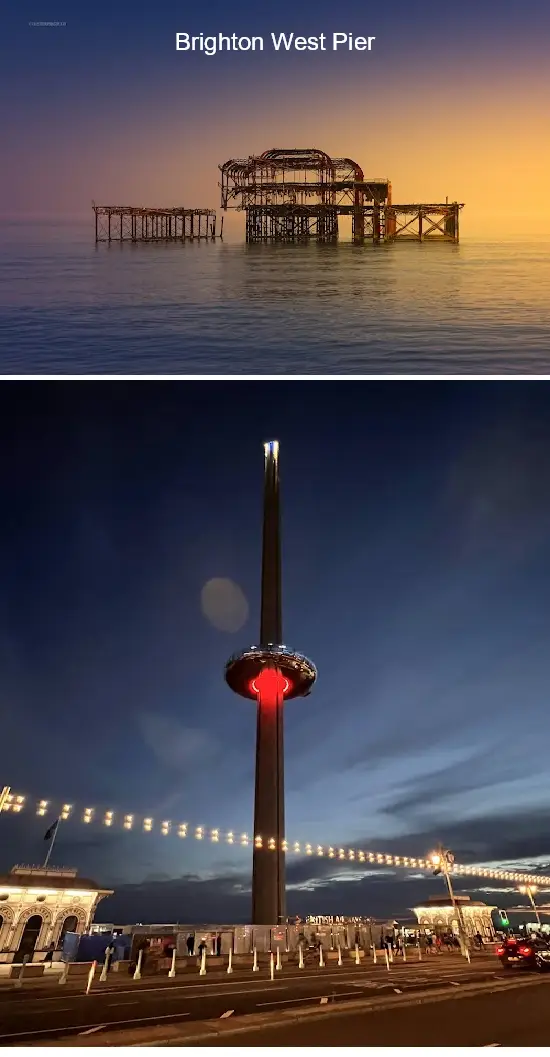
5 /5 Aseem Sharma: There’s something eerily magnetic about Brighton’s West Pier. It doesn’t welcome you with amusements or cafés—it confronts you with absence. A skeletal silhouette rising from the sea, it’s less a structure than a memory made visible. And yet, I find it strangely captivating.
Once a masterpiece of Victorian engineering, today, it’s a ruin, charred by fire, battered by storms, and slowly reclaimed by the sea. But in its decay, it has become something more: a monument to impermanence.
At sunset, the twisted ironwork glows like a cathedral of rust. Seagulls circle its broken spires. Waves crash through its ribs. It’s cinematic, poetic, almost mythic. You don’t just look at it, you feel it. It’s as if the pier is performing its final act, night after night, for anyone willing to watch.
The West Pier doesn’t offer entertainment. It offers reflection. It reminds us that beauty isn’t always polished, and that ruins can be more evocative than restorations. For me, it’s one of Brighton’s most compelling landmarks, not in spite of its collapse, but because of it.