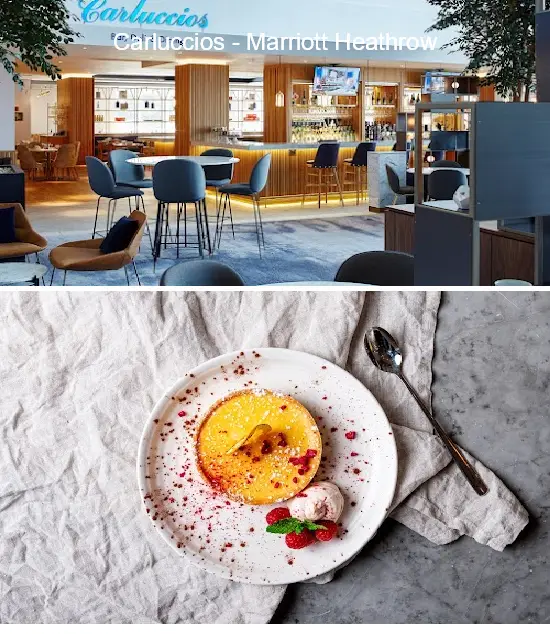
1 /5 Tom D: As part of an exploratory visit to the hotel, I ordered room service from Carluccio’s at the Marriott.
Unfortunately, the experience fell significantly below expected hospitality benchmarks. The order arrived incorrect and entirely cold. While I appreciate that certain elements of a club sandwich are traditionally served at room temperature, the chicken and bacon were tepid rather than freshly prepared, the cheese was the wrong style, and the overall dish lacked the quality control one would expect from a branded restaurant operating within an international hotel environment. The fries, which should of course have been served hot, were also cold.
Equally concerning was the presentation and handling of the dessert, which was delivered uncovered. In any full-service hotel environment, particularly one operating under an established international brand, desserts should be appropriately covered during transit to protect temperature, hygiene, and presentation standards. Serving it exposed not only impacted quality perception but also reflects a lapse in basic room service protocol.
During delivery, the server was talking over the open food and coughed without covering their mouth. Combined with the uncovered dessert, this heightened concerns around basic hygiene awareness and food handling standards. In-room dining is an extension of the restaurant and brand experience, and attention to these fundamentals is critical.
Additionally, the delivery team member was insistent on receiving a cash tip, stating that gratuity could not be added to the bill and advising he would “take any currency.” This placed me, as the guest, in an uncomfortable and unnecessary position and felt misaligned with the seamless, professional service standards typically associated with Marriott properties. It ultimately resulted in me handing over $20 simply to close the interaction.
Following this, I received a call from Anthony, who introduced himself as the restaurant supervisor. Rather than taking ownership, the conversation was abrupt and defensive from the outset. He repeatedly referenced that serving the club sandwich cold was the dish’s “SOP” (standard operating procedure), positioning this as justification for its temperature. When I clarified that the proteins were not freshly prepared, that the cheese was incorrect, and that the fries were also cold, he continued to rely on “SOP” as the rationale. The conversation then shifted to “I’m not the chef, I don’t make it myself.” As a supervisor, accountability for quality, adherence to SOP, and guest recovery sits squarely within his remit, regardless of who physically prepares the dish. When I queried whether that logic would therefore extend to fries being served cold under the same “SOP,” he was unable to respond and ultimately conceded that the dish was not correct.
From an industry perspective, this was a straightforward service recovery opportunity. A sincere apology and an immediate offer to remake the sandwich correctly. which was all I requested on multiple occasions and to ensure it was served warm where appropriate and the dessert properly covered, would have entirely reset the situation. Instead, alternative solutions were repeatedly offered that did not address the core issue, and the interaction compounded the initial error rather than resolving it.
In hospitality, mistakes happen but attitude, accountability, hygiene standards, and service recovery define the brand. On this occasion, those fundamentals were unfortunately absent.